
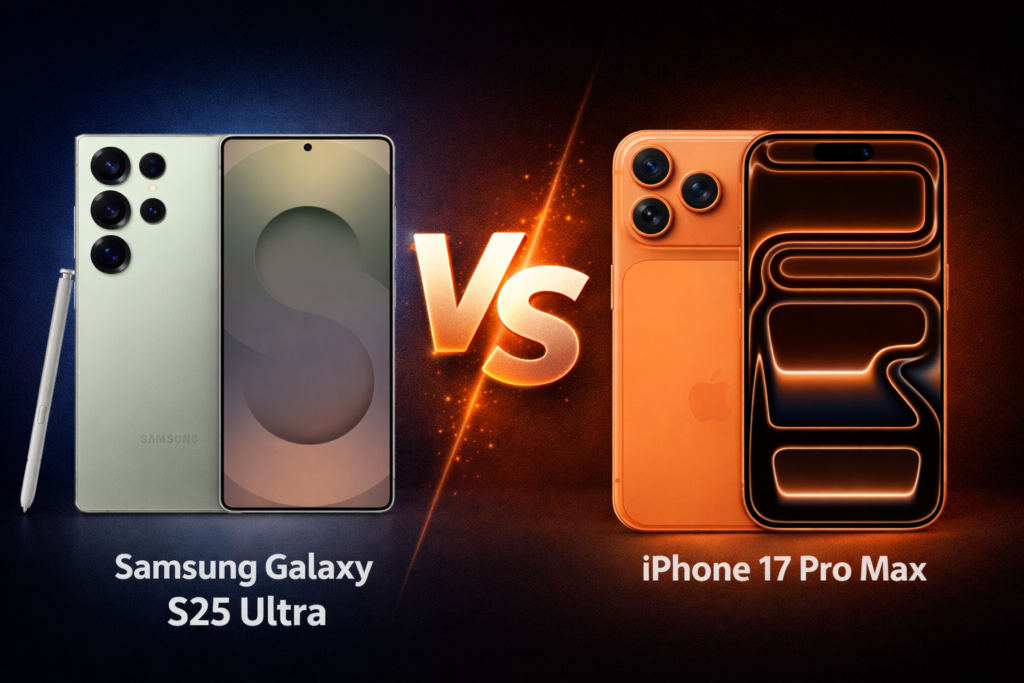
The flagship smartphone battle continues to heat up as Apple and Samsung push the boundaries of mobile technology. The iPhone 17 Pro Max and Galaxy S25 Ultra represent the pinnacle of what each company offers, but they take notably different approaches to achieving excellence. After spending time with both devices, here’s how they stack up against each other.
Design and Build Quality
Apple has refined the iPhone 17 Pro Max with slightly thinner bezels and a new titanium finish that feels less prone to fingerprints than last year’s model. The device maintains that familiar premium feel, though at 221 grams, it’s still a substantial piece of hardware. The camera bump remains prominent, but Apple has made it flow more naturally into the body.
Samsung went bold with the S25 Ultra, keeping the squared-off design but shaving off more weight—it comes in at 233 grams. The integrated S Pen remains a unique advantage, and Samsung’s use of Gorilla Glass Armor on both front and back gives it excellent durability. The matte finish on the titanium frame resists smudges better than previous generations.
Both phones feel like premium devices, but they cater to different preferences. The iPhone feels more refined and comfortable for extended use, while the Samsung offers more functionality with its built-in stylus.
Display Technology
The iPhone 17 Pro Max sports a 6.9-inch Super Retina XDR display with ProMotion technology that now scales from 1Hz to 120Hz. Apple finally increased the base brightness, and outdoor visibility has improved noticeably. The display is sharp, color-accurate, and handles HDR content beautifully.
Samsung counters with a 6.8-inch Dynamic AMOLED 2X panel that’s incredibly bright—peak brightness reaches higher levels than the iPhone in direct sunlight. The S25 Ultra’s adaptive refresh rate is equally smooth, and Samsung’s anti-reflective coating genuinely makes a difference when using the phone outdoors.
For pure specifications, Samsung edges ahead with slightly better peak brightness and the anti-glare technology. However, Apple’s color calibration remains exceptional, and most users would be thrilled with either display.
Performance and Hardware
Apple’s A19 Pro chip continues the company’s dominance in mobile processing power. Real-world performance is stellar—apps launch instantly, gaming is smooth, and even intensive tasks like 4K video editing feel effortless. The 8GB of RAM handles multitasking well, though power users might wish for more.
Samsung equips the S25 Ultra with Qualcomm’s Snapdragon 8 Gen 4, paired with 12GB of RAM. The performance gap between Apple and Qualcomm has narrowed considerably. Daily tasks feel equally snappy, and the extra RAM means you can keep more apps running in the background without reloads.
Gaming performance is excellent on both, though the iPhone tends to maintain more consistent frame rates during extended sessions. For productivity work, the S25 Ultra’s extra RAM and DeX desktop mode give it additional versatility.
Camera Systems
The iPhone 17 Pro Max features a new 48MP main sensor with improved low-light performance, a 48MP ultrawide, and an enhanced 5x telephoto. Apple’s computational photography continues to impress—photos look natural, video stabilization is class-leading, and the new sensor fusion technology produces consistently excellent results.
Samsung packs a 200MP main sensor, a 50MP ultrawide, a 10MP 3x telephoto, and a 50MP 5x periscope lens. The hardware advantage is clear on paper, and Samsung leverages it well. Daytime photos are incredibly detailed, and the zoom capabilities genuinely outperform the iPhone when you need to reach beyond 5x magnification.
The differences come down to processing philosophy. iPhones produce more film-like, natural images straight out of camera. Samsung offers more detail and flexibility, especially if you edit photos afterward. For video, the iPhone maintains its lead with better stabilization and more reliable autofocus.
Battery Life and Charging
Apple doesn’t publish exact battery capacities, but the iPhone 17 Pro Max delivers solid all-day performance. Moderate users will easily push into a second day. Charging tops out at 30W wired and 25W MagSafe wireless charging—not the fastest, but adequate.
The S25 Ultra packs a 5,000mAh battery and supports 45W wired charging plus 15W wireless. In practice, both phones last a full day with mixed use, but Samsung’s faster charging gets you back to full power more quickly. The larger battery capacity gives Samsung a slight endurance edge.
Neither phone will leave you stranded before bedtime with normal use, but if charging speed matters, Samsung wins this round.
Software Experience
iOS remains refined and straightforward. The iPhone 17 Pro Max will receive software updates for years, and the ecosystem integration with other Apple devices is unmatched. The interface is intuitive, though customization options remain limited compared to Android.
Samsung’s One UI 7 over Android 15 offers far more flexibility. You can customize nearly everything, and features like split-screen multitasking and the S Pen integration add genuine productivity benefits. Samsung promises seven years of updates, matching Apple’s long-term support.
Choose based on what matters more: iOS’s simplicity and ecosystem, or Android’s flexibility and customization options.
Price and Value Proposition
The iPhone 17 Pro Max starts at $1,199 for 256GB, with prices climbing to $1,599 for the 1TB model. No microSD expansion means you need to choose your storage carefully upfront.
Samsung prices the S25 Ultra at $1,299 for 256GB, going up to $1,619 for 1TB. The base model costs $100 more than the iPhone, though you’re getting 12GB RAM versus 8GB, and the included S Pen adds value.
Both are expensive flagship devices, and the price difference is minimal enough that it shouldn’t be the deciding factor.
Final Verdict
There’s no clear universal winner here—it depends entirely on your priorities and ecosystem preferences.
Choose the iPhone 17 Pro Max if you: value ecosystem integration with other Apple devices, prefer natural-looking photos and superior video quality, want a more refined and straightforward user experience, or already live in the Apple ecosystem.
Choose the Samsung Galaxy S25 Ultra if you: need the S Pen for productivity or note-taking, want more customization and flexibility, prefer faster charging and slightly better battery life, value the superior zoom capabilities, or need features like DeX mode for desktop-style computing.
Both phones represent the best of what mobile technology offers in 2026. The iPhone delivers that polished Apple experience with excellent performance and cameras. The Samsung counters with more features, better versatility, and impressive hardware specs. You really can’t go wrong with either—just pick the one that fits your workflow and preferences better.