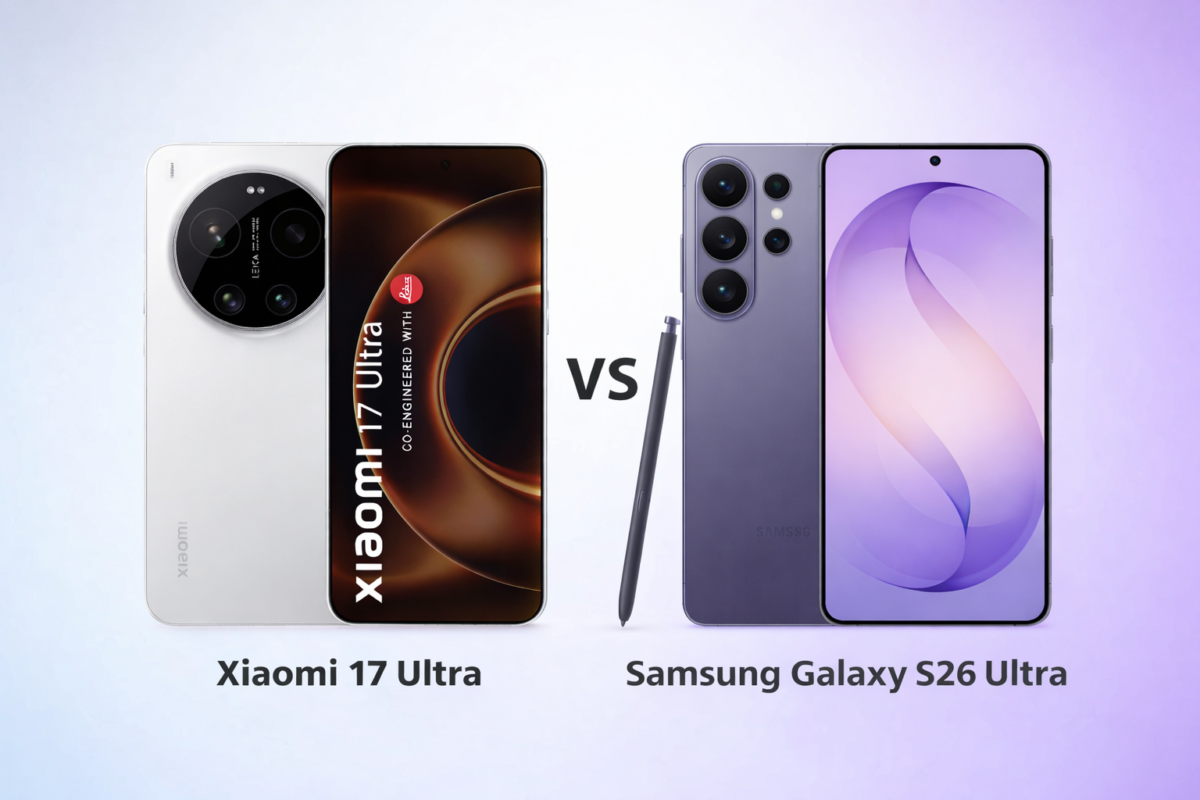
The Xiaomi 17 Ultra and Samsung Galaxy S26 Ultra are two of the most advanced flagship smartphones launched in 2026. Both devices bring top-tier hardware, powerful cameras, and premium design, targeting users who want the best smartphone experience available today.
While Xiaomi focuses on pushing the boundaries of camera technology and battery capacity, Samsung continues to refine its flagship formula with industry-leading displays, long software support, and productivity features.
This detailed comparison looks at the design, display, performance, cameras, battery life, software, and overall value of the Xiaomi 17 Ultra and Samsung Galaxy S26 Ultra.
Design and Build Quality
Both smartphones feature premium construction using high-quality materials and modern design aesthetics.
The Xiaomi 17 Ultra measures 162.9 × 77.6 × 8.29mm and weighs approximately 218 grams. It features a sleek glass body with a large circular camera module on the back. The phone is available in Black, White, and Starlit Green color options. Xiaomi also includes IP68 water and dust resistance, ensuring protection from everyday environmental exposure.
The Samsung Galaxy S26 Ultra has slightly different dimensions at 163.6 × 78.1 × 7.9mm and weighs 214 grams, making it a bit thinner and lighter. Samsung uses Gorilla Armor 2 glass on the front and Gorilla Glass Victus 2 on the back, combined with an aluminum frame for durability.
Samsung’s flagship also includes S Pen stylus support, which gives it an additional advantage for users who want productivity tools and note-taking features.
Display Technology
Both smartphones feature large, high-quality displays designed for immersive media consumption and smooth everyday use.
The Xiaomi 17 Ultra comes with a 6.9-inch HyperRGB OLED display with a resolution of 2608 × 1200 pixels. The display supports an adaptive refresh rate from 1Hz to 120Hz, ensuring smooth scrolling and improved power efficiency. Xiaomi also advertises an impressive 3500-nit peak brightness, along with support for HDR10+, Dolby Vision, and 12-bit color depth. These features provide vibrant colors and excellent outdoor visibility.
The Samsung Galaxy S26 Ultra features a 6.9-inch Dynamic LTPO AMOLED 2X display with a higher resolution of 1440 × 3120 pixels. Samsung’s panel also supports 120Hz refresh rate, HDR10+, and advanced anti-reflective technology, which improves visibility in bright environments.
While Samsung offers a sharper display due to its higher resolution, Xiaomi’s panel focuses on extremely high brightness and advanced color reproduction.
Performance and Hardware
Performance is another area where both phones deliver flagship-level power.
The Xiaomi 17 Ultra runs on the Snapdragon 8 Elite Gen 5 processor, built using a 3nm manufacturing process. The chipset includes high-performance cores running up to 4.6GHz, delivering excellent speed for gaming, multitasking, and AI-driven tasks.
The phone is available with 16GB LPDDR5X RAM and storage options of 512GB or 1TB UFS 4.1, allowing faster data access and improved overall system responsiveness.
Similarly, the Samsung Galaxy S26 Ultra also uses the Snapdragon 8 Elite Gen 5 processor, combined with 12GB or 16GB RAM and up to 1TB storage.
In practical usage, both smartphones provide extremely fast performance, capable of handling demanding games, heavy multitasking, and AI features without noticeable lag.
Camera System
Camera performance is one of the most important aspects of flagship smartphones, and both devices offer impressive camera hardware.
The Xiaomi 17 Ultra features a Leica-engineered triple camera system, designed for professional-level photography. The main camera uses a 50MP 1-inch Light Fusion sensor, which captures more light and produces detailed images in both bright and low-light conditions.
The phone also includes a 200MP telephoto camera with optical zoom capabilities and advanced stabilization. Additionally, the 50MP ultra-wide camera provides a wide field of view for landscape photography.
Xiaomi also integrates several professional photography features such as Leica color profiles, RAW shooting, HDR imaging, and advanced video recording including 8K video and Dolby Vision recording.
The Samsung Galaxy S26 Ultra uses a quad-camera setup, led by a 200MP main camera. The device also includes a 10MP telephoto camera with 3x optical zoom, a 50MP periscope telephoto camera with 5x zoom, and a 50MP ultra-wide camera.
Samsung’s camera system focuses on versatility, offering multiple focal lengths and advanced image processing for consistent results across different lighting conditions.
Front Camera
For selfies and video calls, the Xiaomi 17 Ultra includes a 50MP autofocus front camera, which allows users to capture highly detailed selfies and high-resolution video.
In comparison, the Samsung Galaxy S26 Ultra uses a 12MP front camera with advanced image processing and HDR support.
Although Samsung’s front camera is optimized for consistent results, Xiaomi’s higher resolution sensor offers greater detail in selfie photography.
Battery and Charging
Battery life is one of Xiaomi’s biggest advantages in this comparison.
The Xiaomi 17 Ultra features a 6000mAh battery, which is larger than most flagship smartphones. It supports 90W wired fast charging and 50W wireless charging, allowing the device to recharge quickly.
The Samsung Galaxy S26 Ultra, meanwhile, includes a 5000mAh battery with 60W wired charging and 25W wireless charging.
Although Samsung’s battery optimization is efficient, Xiaomi’s larger battery and faster charging speeds provide a noticeable advantage in terms of endurance and charging convenience.
Software and AI Features
The Xiaomi 17 Ultra runs HyperOS 3, based on Android 16. Xiaomi integrates several AI features, including AI writing tools, speech recognition, smart search, and AI-powered wallpapers.
Samsung’s Galaxy S26 Ultra runs One UI 8.5 on Android 16, offering a highly refined user interface and strong ecosystem integration. One of Samsung’s biggest strengths is its long software support, providing up to seven years of Android updates and security patches.
Connectivity and Additional Features
Both smartphones support modern connectivity standards including 5G, Wi-Fi 7, Bluetooth 6.0, NFC, and advanced GPS systems.
The Xiaomi 17 Ultra includes additional features such as an ultrasonic fingerprint sensor, stereo speakers with Dolby Atmos, and an IR blaster for remote control functionality.
Samsung’s device adds Samsung DeX desktop mode and S Pen stylus functionality, which can significantly enhance productivity for certain users.
Price Comparison
The Samsung Galaxy S26 Ultra starts at approximately ₹1,39,999 in India, depending on the storage configuration.
The Xiaomi 17 Ultra is expected to launch in a similar premium price range globally, with estimated pricing between ₹1,20,000 and ₹1,40,000 depending on the storage variant.
Both devices clearly belong to the ultra-premium flagship smartphone category.
Final Verdict
The Xiaomi 17 Ultra and Samsung Galaxy S26 Ultra both represent the cutting edge of smartphone technology in 2026.
The Xiaomi 17 Ultra stands out with its large battery, extremely fast charging, and Leica-powered camera system, making it an excellent choice for photography enthusiasts and power users.
On the other hand, the Samsung Galaxy S26 Ultra offers a sharper display, longer software support, and productivity features such as the S Pen and Samsung DeX, making it ideal for users who want a versatile flagship device.
Ultimately, the best choice depends on individual priorities, whether that is camera innovation and battery performance or ecosystem features and long-term software support.
Samsung Galaxy S26 Ultra vs Xiaomi 17 Ultra – Full Specifications Comparison
| Category | Samsung Galaxy S26 Ultra | Xiaomi 17 Ultra |
|---|---|---|
| Brand | Samsung | Xiaomi |
| Model | Galaxy S26 Ultra | Xiaomi 17 Ultra |
| Release Date | February 25, 2026 | March 11, 2026 |
| Launched in India | Yes | Yes |
Design & Build
| Feature | Samsung Galaxy S26 Ultra | Xiaomi 17 Ultra |
|---|---|---|
| Dimensions | 163.6 × 78.1 × 7.9 mm | 162.9 × 77.6 × 8.29 mm |
| Weight | 214 g | 219 g |
| Build Material | Gorilla Armor 2 front, Victus 2 back, aluminum frame | Glass front, aluminum alloy frame |
| Water Resistance | IP68 | IP69 |
| Colours | Black, Blue, Purple, White | Black, White |
Display
| Feature | Samsung Galaxy S26 Ultra | Xiaomi 17 Ultra |
|---|---|---|
| Display Size | 6.9-inch | 6.9-inch |
| Display Type | Dynamic AMOLED 2X | LTPO AMOLED |
| Refresh Rate | 120Hz | 120Hz |
| Resolution | 1440 × 3120 pixels | 1200 × 2608 pixels |
| Resolution Standard | 1.5K | 1.5K |
| Screen Protection | Gorilla Armor 2 | Xiaomi Shield Glass 3.0 |
| Pixel Density | ~500 PPI | ~416 PPI |
Performance & Hardware
| Feature | Samsung Galaxy S26 Ultra | Xiaomi 17 Ultra |
|---|---|---|
| Processor | Snapdragon 8 Elite Gen 5 | Snapdragon 8 Elite Gen 5 |
| CPU | Octa-core | Octa-core |
| RAM | 12GB / 16GB | 12GB |
| Storage | 256GB / 512GB / 1TB | 512GB |
| Expandable Storage | No | No |
Camera
| Feature | Samsung Galaxy S26 Ultra | Xiaomi 17 Ultra |
|---|---|---|
| Rear Cameras | 200MP + 50MP + 50MP + 10MP | 50MP + 200MP + 50MP |
| Number of Cameras | 4 | 3 |
| Front Camera | 12MP | 50MP |
| Rear Flash | Yes | Yes |
| Lens Type | Telephoto + Ultra-wide + Telephoto | Wide + Telephoto + Ultra-wide |
Battery & Charging
| Feature | Samsung Galaxy S26 Ultra | Xiaomi 17 Ultra |
|---|---|---|
| Battery Capacity | 5000mAh | 6800mAh |
| Fast Charging | 60W | 90W |
| Wireless Charging | Yes | Yes |
| Wireless Charging Speed | 25W | 50W |
| Removable Battery | No | No |
Software
| Feature | Samsung Galaxy S26 Ultra | Xiaomi 17 Ultra |
|---|---|---|
| Operating System | Android 16 | Android 16 |
| Custom UI | One UI 8.5 | HyperOS 3 |
| AI Features | Yes | Yes |
Connectivity
| Feature | Samsung Galaxy S26 Ultra | Xiaomi 17 Ultra |
|---|---|---|
| SIM Support | Dual Nano SIM | Dual Nano SIM |
| 5G Support | Yes | Yes |
| Wi-Fi | Wi-Fi 7 | Wi-Fi 7 |
| Bluetooth | v5.4 | v6.0 |
| NFC | Yes | Yes |
| USB Type-C | Yes | Yes |
Sensors
| Feature | Samsung Galaxy S26 Ultra | Xiaomi 17 Ultra |
|---|---|---|
| Fingerprint Sensor | In-display | In-display |
| Accelerometer | Yes | Yes |
| Gyroscope | Yes | Yes |
| Proximity Sensor | Yes | Yes |
| Compass | Yes | Yes |
| Temperature Sensor | No | Yes |
Frequently Asked Questions (FAQ)
1. Which phone is better: Xiaomi 17 Ultra or Samsung Galaxy S26 Ultra?
Both smartphones are flagship devices with powerful hardware. The Xiaomi 17 Ultra offers advantages such as a larger battery, faster charging, and Leica-tuned camera system, while the Samsung Galaxy S26 Ultra provides higher display resolution, S Pen support, and longer software updates. The better option depends on whether you prioritize battery and camera innovation or productivity features and software support.
2. Do Xiaomi 17 Ultra and Samsung Galaxy S26 Ultra use the same processor?
Yes. Both smartphones are powered by the Snapdragon 8 Elite Gen 5 processor built on a 3nm architecture, which delivers excellent performance for gaming, multitasking, and AI-based tasks.
3. Which phone has the better camera system?
The Samsung Galaxy S26 Ultra uses a 200MP main camera with additional telephoto lenses, offering flexible zoom options. The Xiaomi 17 Ultra features a Leica-tuned camera system with a large 1-inch sensor and 200MP telephoto lens, which focuses on professional-grade photography and natural color reproduction.
4. Which phone offers better battery life?
The Xiaomi 17 Ultra has a larger battery capacity of around 6800mAh, compared to the 5000mAh battery in the Samsung Galaxy S26 Ultra. Xiaomi also supports 90W wired charging and 50W wireless charging, which makes charging significantly faster.
5. Which smartphone has the better display?
Both phones feature 6.9-inch AMOLED displays with a 120Hz refresh rate. However, the Samsung Galaxy S26 Ultra offers a higher QHD+ resolution (1440 × 3120), while the Xiaomi 17 Ultra focuses on higher brightness levels and advanced color technology.
6. Does Xiaomi 17 Ultra support wireless charging?
Yes. The Xiaomi 17 Ultra supports 50W wireless charging, along with 90W wired fast charging and reverse wireless charging for charging accessories.
7. Which phone is better for gaming and performance?
Since both devices use the Snapdragon 8 Elite Gen 5 chipset, they deliver similar flagship performance. However, Xiaomi’s advanced cooling system and larger battery may help maintain stable performance during long gaming sessions.
8. Which phone is more durable?
Both smartphones offer IP-rated water and dust resistance. The Samsung Galaxy S26 Ultra uses Gorilla Armor 2 glass, while the Xiaomi 17 Ultra features Xiaomi Shield Glass protection and IP69 certification, offering additional durability in certain conditions.
9. What is the price of Xiaomi 17 Ultra and Samsung Galaxy S26 Ultra?
The Samsung Galaxy S26 Ultra starts at around ₹1,39,999 in India, depending on the storage variant. The Xiaomi 17 Ultra is expected to launch in a similar premium price range globally.
10. Which phone should you buy in 2026?
If you prefer long software support, productivity features like the S Pen, and a high-resolution display, the Samsung Galaxy S26 Ultra is a strong choice. However, if you want a larger battery, faster charging, and Leica camera technology, the Xiaomi 17 Ultra may offer better value.
Read more: Apple iPhone 17e Review: Price in India, Specifications, A19 Chip, Camera & Battery-price-specs/